An upright granite headstone usually runs $2,000 to $5,000, covering the die and base, the carving, and hauling it to the plot.
Marble, granite or bronze? What fifty winters do to the lettering
Common questions
The sugaring test
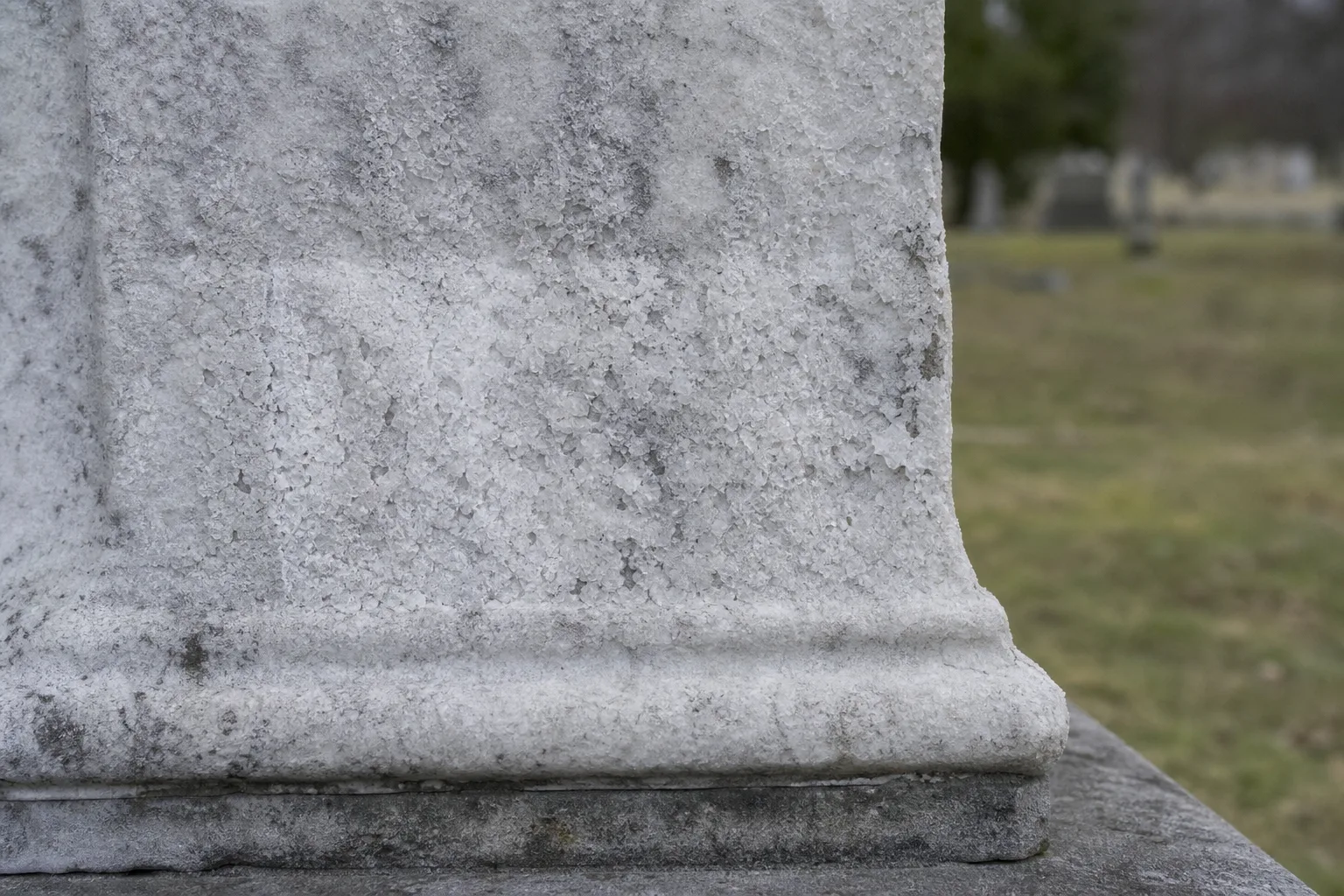
Run a hand across an old marble face; a gritty, sugary feel means the crystal structure has opened up. Once that starts, freeze-thaw cycles flake the surface away in small chips.
Walk the old section
An hour spent reading markers from the 1890s and the 1950s in the same cemetery tells you how the local weather treats each material. Compare the weather-facing side with the sheltered side of the same stone.
What granite loses
The stone is effectively inert, so what degrades is applied rather than inherent. Letter paint chalks, polish hazes where sprinklers hit it, and epoxied inserts loosen.
Read next
The stone you choose is really two decisions wearing one price tag: the material that carries the name, and the method that puts the name into it. Both age, but they age on different schedules and for different reasons, and the second decision is the one that decides whether a stranger can read the marker in 2075. A careful reader of a monument quote learns to separate them, because dealers often bundle them into a single line item and the cheaper lettering method rarely announces itself as the cheaper one.
Why marble surrenders its inscription first
Marble is recrystallized limestone, which means it is calcium carbonate, which means rain dissolves it. Not dramatically, and not evenly, but continuously, and the dissolution concentrates wherever water lingers longest, which is the bottom of every cut letter. Sulfur and nitrogen compounds in precipitation accelerate the reaction, and the Environmental Protection Agency is the federal body responsible for tracking that chemistry in the atmosphere. The visible result is a marker whose surface has gone slightly sugary to the touch and whose serifs have rounded into suggestion. Fifty winters of freeze and thaw inside those same softened pores finish the job by spalling small flakes away.
Older marble in an established cemetery tells you exactly what to expect, and it is worth an hour of walking the grounds before signing anything. Look at the 1890s section, then the 1950s section. The names facing the prevailing weather will be markedly worse than the names on the sheltered faces of the same stones, and the lichen will have colonized the shallow letters rather than the deep ones. That comparison, done on the actual site with the actual local rainfall, is more useful than any brochure.
What actually fails on granite
Granite is quartz and feldspar, essentially inert against rain, and the letters cut into it in 1975 are still sharp. What fails on granite is everything applied to its surface rather than removed from it. Lithichrome paint in the letters chalks and fades, typically needing renewal on a scale of years rather than decades, and the polished face can haze where a sprinkler head has been throwing hard water at it since the Ford administration. Bronze inserts pull loose if their epoxy was thin. The stone itself holds; the finishes are the maintenance item.
The other granite failure is structural and belongs to the setting, not the material. A die that was set on an insufficient footing, or on ground that had not finished settling, will lean, and the lean will open the mortar joint between die and base so that water gets in and freezes. A careful reader checks the quote for footing depth and for what the cemetery requires underneath, because that specification, not the stone grade, is what keeps the marker plumb through fifty cycles.
Sandblasted, laser etched, hand cut
Sandblasting through a rubber stencil is the standard method, and it produces a V-cut or flat-bottomed letter with real depth, usually a good fraction of an inch, which is why it survives paint loss. Read it from the side of the stone: if the letter has walls, it will still be legible when the color is gone. Hand cutting with pneumatic chisels goes deeper still and gives crisper interior corners on serif faces, at a labor cost that shows up plainly on the estimate. Both remove stone. That is the durable category.
Laser etching does not. It fractures the polished surface at a shallow depth to create a gray image, which is what makes photographic portraits and detailed scenes possible on black granite, and the effect is genuinely fine when new. Its longevity depends on that polish staying intact, so etched work belongs on a protected face, ideally the back of an upright rather than the weather side or the top of a flush marker where boots and mowers pass. Many families order both: sandblasted names, etched imagery.
Bronze on a granite base, priced over decades
Cast bronze plaques on a granite base are the standard flat marker in memorial parks, and they do not corrode away; they build a protective patina and keep their raised, cast letters indefinitely. The maintenance is cosmetic and periodic, cleaning and rewaxing to keep the dark oxidation from flattening the contrast, and some cemeteries sell that service on a schedule. Ask who performs it, at what interval, and at what current charge. A plaque properly bedded on granite, with its anchor bolts and its base flush to grade, is among the lowest-effort markers a cemetery holds.
The useful question at the counter is not which material lasts, but which combination puts the name where weather cannot reach it: deep letters in an inert stone, or raised letters in metal, with the delicate work turned away from the sky.